|
|  | The Whifflet, now a suburb of Coatbridge, North Lanarkshire, was once its own distinctive village. It was originally known as wheat flats but over time the name appears to have developed into Whifflet - older people still call it Wheeflet. It is dominated by its main street which has many shops, pubs and bookmakers and is towered over by the post-war built Calder flats. The Whifflet has been an area of Coatbridge which has historically been the centre of much mining activity. One of the Whifflet pits in the 19th century reached a depth of 330 feet underground.
In 1882-4, Frances Groome's Ordnance Gazetteer of Scotland described the parish of Garturk: Garturk, a quoad sacra parish in the south-eastern district of Old Monkland parish, Lanarkshire. It was constituted in January 1870; and its post-town is Coatbridge, 1¼ mile to the NW. It comprises a compact area, including the villages of Whifflet, Rose hall, and Calder, and also the Calder Iron-works, belonging to the firm of William Dixon (Limited). These works are interesting, as the place where the famous and valuable blackband ironstone, which has proved such a source of wealth to Scotland, was first discovered.
The discovery was made in 1805 by Robert Mushet, from whom it received the name of 'Mushet Blackband,' and as such it is still known. In this parish there are also several other large iron and engineering works, and numerous coal mines of considerable depth. The parish, which is in the presbytery of Hamilton and synod of Glasgow and Ayr, was endowed at a cost of upwards of £8000, of which £1500 was from the General Assembly's Endowment Fund, the remainder being raised by voluntary subscription. The church, erected in 1869 and renewed in 1880, is a handsome edifice-the interior, which is richly ornamented, being one of the finest specimens of the Decorated style to be seen in this part of the country. Adjoining the church and under the same roof with it is a very comfortable manse, prettily situated amidst a plantation of trees. The parish contains two good schools. One close beside the church, supported by the proprietors of Calder Iron-works; the other in Rosehall, maintained by the owners of Rosehall colliery. With respective accommodation for 227 and 173 children, these schools had (1881) an average attendance of 278 and 208, and grants of £238, 9s. and £172, 1s.
Population (1871) 3883, (1881) 4266. 
Old Monkland Poorhouse - now Coathill HospitalCoathill Hospital is located at Hospital Street, just off School Street, near the Whifflet. In the 1930s and 1940s, the poorhouse operated as the Old Monkland Home Poor Law Institution. A report in 1946 described its location as 'a depressing site in Coatbridge' with a 69-bed hospital and an asylum for 'milder types of lunatic'. Inside 'the main block of this institution is old and done, with dark corridors and crowded dormitories, and the impression is one of general neglect. The dining room is very gloomy.' The report recommended that the premises be abandoned.
Coatbridge Tin Plate Works.
These works, which are situated on one of the most eligible sites in the
district, on the estate of Whifflat, at the Laigh Coats, were started
at the latter end of the present year. They are the only works of the same
description in Scotland, and the proprietors (Messrs Baillie and Bell)
deserve credit for their enterprising spirit in thus adding another branch
to our iron manufacture, which, it is calculated, will give employment to
about seventy individuals. The works are built on the most approved
principles - the machinery and fittings are of the best description, with
all modern improvements. There are two puddling furnaces, two lumping
furnaces, a hollow fire, a softening fire, with arrange of tinning pots, a
couple of engines to propel the rolls, a Condie hammer, and every other
appliance necessary for manufacturing the iron through all the various
stages from puddling, hammering, rolling, re-heating, cutting, softening,
pickling, and lastly, tinning, when it is finally packed in boxes, in
quantities of 3/4 to 1 cwt. in weight, ready for the market. The estimated
produce of such a work is about 500 boxes per week. In the tinning process,
females are employed, so that this is a new phase in iron manufacture in the
district. The works are advantageously placed for carriage of the raw
material or produce both by railway or canal, and with its energetic
proprietors, there can scarcely be a doubt as to its future prosperity.

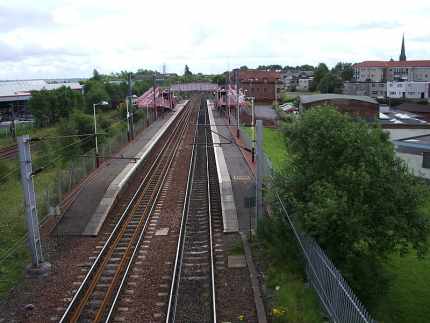
Lots of information on this and other UK workhouses/ poorhouses on Peter Higginbotham's website at www.workhouses.org.uk Railway information courtesy of Jim Howie www.jhowie.f9.co.uk/monklands.htm |
|