|
 |
||
|
|

|
Murray and Paterson 1868-1971
Firm
constructed mining machinery: in
1880s firm constructed two
locomotives, one for South America,
probably Brazil; the other (WN 205)
went to Australia in 1885. Firm also
rebuilt and repaired locomotives.
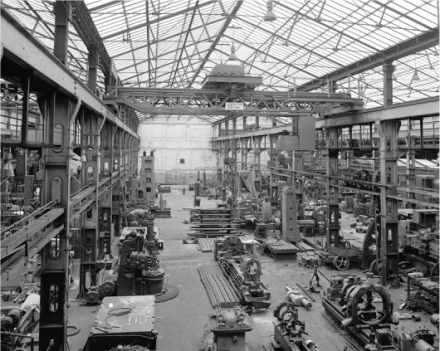
For those and there are many who will recall the Manufacturing and Engineering expertise of companies like Murray & Paterson & Lamberton and [without doubt others too] their demise must surely strike a sad note on a distinctive period of local industrial history. Considering that both these companies were each in business for over 100 years in Coatbridge bringing industry and employment to thousands of townspeople over time we must surely ponder the end of something valuable that used to exist, especially when it happens slowly but was it predictable? In the 1960s there were signs that the order books were already depleted, now whether that was to due to changing manufacturing techniques, competitive market forces, or simply that the machines and devices made by these two great companies were no longer required or in insufficient quantity to maintain their viability? I reflect on how an account of low orders in the 1960s was affecting these Coatbridge companies and the subsequent development of the UK postmodern economy. The new paradigm trades appeared to be hairdressers [and other bodily improvers], management consultants, celebrities and managers! My impression during frequent visits to the UK was that there was sparse room for assembly lines, hard work or ingenious engineering?
Britains manufacturing sector if one believes what is written has dropped dramatically over the past decades. Employment in manufacturing had to follow suit likewise. Will it come about that people eventually realise it was a tad premature to wave goodbye to the old economy that actually produced something versus a new nebulous creative economy, as if it was not creative to produce machinery, cars and the like? A recent report indicated that manufacturing in the UK had increased by 14% so it is to be hoped that the decline has been reversed.
There will be answers we are sure but that question is not part of this brief. Our aim is to highlight what we have lost and perhaps never appreciated in the first place until too late. Murray & Paterson closed in 1971 and Lambertons 1991 and so ended a manufacturing era with lost opportunity for local livelihood and a dearth of training for young engineers. The writer who commenced his working life as a lowly apprentice with Lambertons did eventually during his business career meet innumerable Engineers from these two companies in many far flung corners of the world. Many of these individuals were met personally at sea in the Merchant Navy, working tugboats & power station in the Pacific Islands, projects in Australia, New Zealand and Canada, oil rigs in the Gulf of Mexico. It was always amusing when communicating between vessels and once an accent was detected the inevitable first question was where do you hail from? Both these companies provided a source of trained Engineers for the betterment of the many. So what now we must ask ourselves? What has replaced this opportunity to obtain gainful employment and enhanced career possibilities, especially one that offers some kind of advantage? The world will always need Engineers very little functions without their involvement. Simply put, opportunities lost possibly for ever for Coatbridge! This is not to say that new opportunities will not be available in electronics and similar fields but their spectrum will not be as encompassing as before! We are indebted to Mr John M. McGregor of Woking for retrieving and providing the historical background for Murray & Paterson. The narrative you will read for the Murray & Paterson history was compiled in 1968, on the 100th anniversary of the company being founded. As you will observe John has a filial connection to the old company, thank you John, your input very much appreciated.
Murray & Paterson 1979 - 1985 In 1979 Murray & Paterson built a new foundry beside their engineering works in Brown Street with improved facilities and larger capacity.
The company in Brown street
manufactured specialised Tube
bending equipment for mainly for
shipbuilding industry.
Another popular sight in the
machine shop was ships rudders
and stabilisers that were bored
out and steering shafts fitted.
The rudders were aligned with
tensioned piano wires.
Cast iron Kiln Cars for the
brick industry were made and
sent to Murray and |Paterson to
have high temperature cast iron
wheels fitted
Brown Street Dundyvan - note the Murray and Paterson factory at bottom of street - on mouse over shows Brown Street as it is today - enlargement below.
Terex the heavy earth moving
equipment manufacturer based in
Chapelhall sent rear and
intermediate drive axles (called
banjo's) to be machined.
Cast steel casings either for
pumps or turbines were machined
from rough castings on boring
machines.
At a workshop out the back of
the main factory there was a
small brass foundry. Vital for
supplying non ferrous metal
bearing castings to support the
Brown Street operation. The shop
was also capable of producing
"White Metal" bearings. It is
believed that the factory in
Kirkwood Street, Langloan was
solely casting specialised
bearing and Brown Street
machined the castings into
working bearings.
|
|
||||||||||||||
|
Copyright
Monklands
Memories 2000-2017 |
||||||||||||||